The conversation ended hours ago. You said goodnight, you put the phone down, you moved on to the next thing. But your mind didn’t. It keeps going back: what you said, how they looked, the pause before they answered, the sentence you wish you could take back.
Replaying conversations in your head is one of the most common forms of overthinking. It can feel responsible, as if going over it one more time will finally settle it. Usually it doesn’t. This article explains why the replay happens and gives you five faith-based steps, built on the T.R.A.I.N. method, to help a conversation come to rest.
Why your mind keeps replaying conversations
Your mind replays what feels unfinished. A conversation with no clear ending, a reaction you couldn’t read or a moment you’d handle differently all leave an open loop, and the mind keeps returning to close it.
A few things tend to make the loop louder:
- Uncertainty. You don’t know how your words landed, so your mind fills the gap with guesses.
- Silence afterwards. A slow reply or no reply can feel like an answer, even though it usually isn’t one.
- Caring about the person. The more the relationship matters, the more the moment echoes.
- Quiet and tiredness. Replays often get loudest at night, when there’s nothing else asking for your attention.
None of this means something is wrong with you. It means your mind is trying to protect a relationship. The problem is that replaying feels like solving, while it mostly repeats.
Reflection or replay? A simple test
Not all thinking about a conversation is unhelpful. (For a wider look at this, see How to Stop Anxiety and Ruminating Thoughts.) Reflection notices one lesson and then ends. Replay runs the same scene again without adding anything new.
Ask yourself one question: Am I learning something new, or hearing the same scene again? If it’s the same scene, it’s time to stop reviewing and start responding.
5 steps to let a conversation rest
These steps follow T.R.A.I.N., the five-part reflection method behind DivertMind. Give each one a minute or two. Writing your answers down helps, because paper holds a thought so your mind doesn’t have to.
1. Track the trigger
Notice what pulled you back into the conversation just now. Was it a notification, seeing their name, a quiet moment, being tired? You’re not judging the thought yet, only naming where it came from. Naming the trigger is often the first moment you step outside the replay instead of living inside it.
2. Recognize the pattern
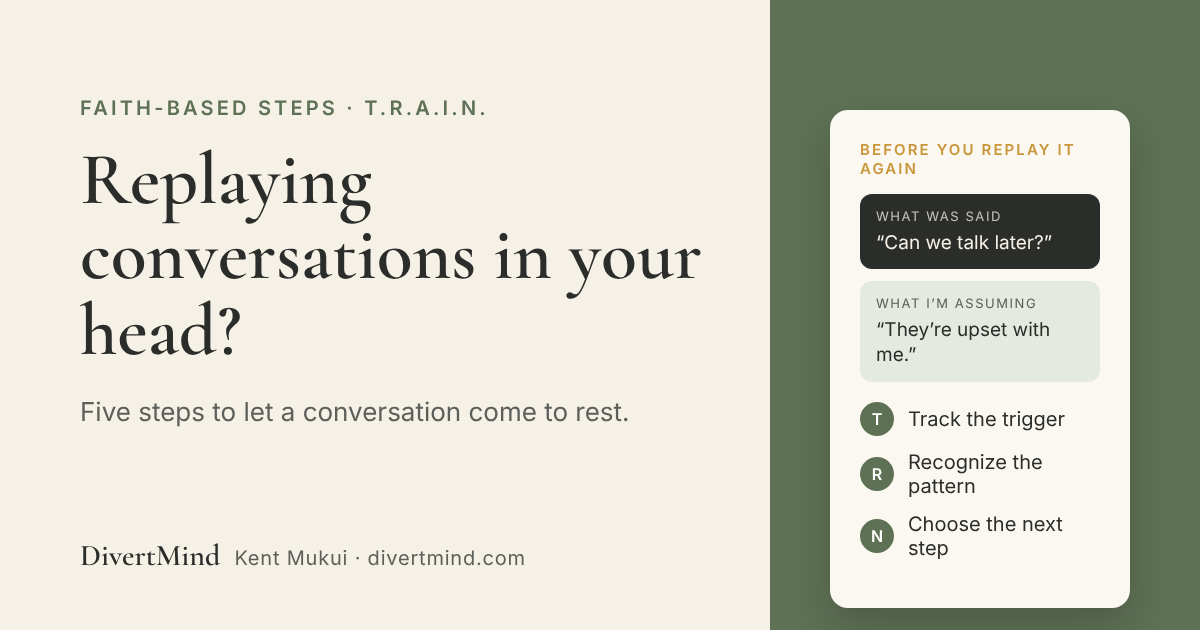
Take a page and draw a line down the middle. On the left, write what was actually said, as close to the real words as you can. On the right, write what you’re assuming: what they meant, what they think of you, what happens next.
Most of the weight usually sits on the right-hand side. Seeing it on paper makes it easier to recognize the pattern: you are replaying a story about the conversation, not the conversation itself.
3. Align with truth
Hold the replay up against something steadier than your guesses. Paul gives a filter for exactly this kind of moment:
Finally, brothers, whatever things are true, whatever things are honorable, whatever things are just, whatever things are pure, whatever things are lovely, whatever things are of good report; if there is any virtue, and if there is any praise, think about these things.
Philippians 4:8 (World English Bible)
Ask: Which part of this replay is true? Which part is a guess? You can only respond to what is true. The guesses can wait, and most of them will fade once you stop feeding them.
4. Invite God in
You don’t need polished words. Bring the conversation to God as it is, including the part you’re worried you got wrong.
Search me, God, and know my heart. Try me, and know my thoughts.
Psalm 139:23 (World English Bible)
A simple prayer is enough: “Lord, You were there for that conversation. Show me if there is anything I need to make right, and help me let go of what isn’t mine to carry.”
5. Choose the next right thought
Now decide. A replayed conversation usually needs one of three responses:
- Clarify. If something was genuinely unclear, a short, calm message can settle it. Wait until you can be gentle.
- Make it right. If you said something unkind, a sincere apology is a complete step, whatever the other person does with it.
- Let it rest. If nothing needs to be done, choose that on purpose. Write one sentence you can return to, such as “I said what I meant, and I can leave the rest with God.”
If it is possible, as much as it is up to you, be at peace with all men.
Romans 12:18 (World English Bible)
If one conversation keeps coming back, the After the Conversation Workbook walks through these steps on paper ($4.99 printable on Etsy).
Notice the words as much as it is up to you. Your part has limits. Their response, their mood and their timing are not yours to manage.
If you need to follow up, keep it small
When a conversation really does need a second word, a short message usually lands better than a long explanation. For example: “I’ve been thinking about our conversation earlier. I don’t think I said what I meant very well. Could we talk for a few minutes this week?” Then let the reply come in its own time.
So, then, my beloved brothers, let every man be swift to hear, slow to speak, and slow to anger;
James 1:19 (World English Bible)
A short prayer for a replaying mind
Father, my mind keeps going back to that conversation. Thank You that You hear what I meant, even when my words came out wrong. Give me the courage to make right what I can, and the peace to release what I can’t. Quiet the replay, and help me rest tonight. Amen.
When to reach out for support
Replaying a conversation now and then is part of caring about people. If replaying has become constant, is keeping you from sleep, or is tied to a relationship where you feel unsafe, please talk with someone you trust: a pastor, a counselor or your doctor. DivertMind shares reflection tools, not therapy or medical treatment.
Get the free T.R.A.I.N. Starter Kit
The five steps on one page, a daily reflection sheet and a short guide for your first week.
Free PDF by email after you confirm your address. Unsubscribe anytime.Related reading
DivertMind articles are faith-based reflections written from lived experience, not therapy or medical advice. If you are struggling, please talk with a doctor, counselor or pastor you trust. In a crisis, call or text 988 (US) or contact local emergency services.
About the author
Kent Mukui is the founder of DivertMind and creator of the T.R.A.I.N. Method. He writes Scripture-grounded reflections and develops guided journals and educational workbooks for people navigating overthinking, ADHD mental noise and difficult seasons. He is also the author of Take Back Your Thoughts, written under the pen name Eli Divert and available on Amazon. Meet Kent Mukui.
Leave a Reply