The conversation ended hours ago. Maybe days. But part of you is still in the room, rewinding what you said, rehearsing what you should have said, and guessing what they meant by that pause.
If that’s you, you’re not strange and you’re not broken. You’re replaying, and almost everyone does it.
What replaying actually is
Psychologists use the word rumination for repetitive, looping thought: going over the same material again and again without moving forward (Psych Central). Replaying conversations is one of its most common forms. Writers at Psychology Today and Simply Psychology describe the same pattern: dissecting every word, scrutinizing reactions and judging yourself afterwards. If it shows up as general worry too, see how to stop anxiety and ruminating thoughts.
Why your mind keeps going back
Replaying usually means your mind is trying to finish something that feels unfinished. Three motives show up again and again:
- Certainty. “Did they mean it?” Your mind keeps checking because it hasn’t been given an answer, and often can’t be.
- A do-over. Rehearsing the perfect reply feels productive. It rarely changes anything, but it keeps the hurt fresh.
- Protection. If a conversation felt unsafe or embarrassing, your mind scans it for danger so it “won’t happen again.”
Why “just stop thinking about it” doesn’t work
Trying to force a thought away tends to make it louder (Introvert Dear). The goal isn’t to win the argument in your head. It’s to stop letting it run unattended.
I know this pattern from the inside. There have been times when a conversation ended minutes earlier, but in my mind I was still having it hours later, replaying what was said and imagining what I should have said differently.
Replaying vs. reflecting
Going back to a conversation isn’t always wrong. Sometimes there’s something to learn or repair. The difference:
| Replaying | Reflecting |
|---|---|
| Goes over the same moment again and again | Looks at it once, on purpose |
| Asks “Why did I…?” | Asks “What now?” |
| Builds a verdict about you or them | Separates facts from story |
| Leaves you more tired | Ends with one clear step |
A 5-minute way to give the replay an ending
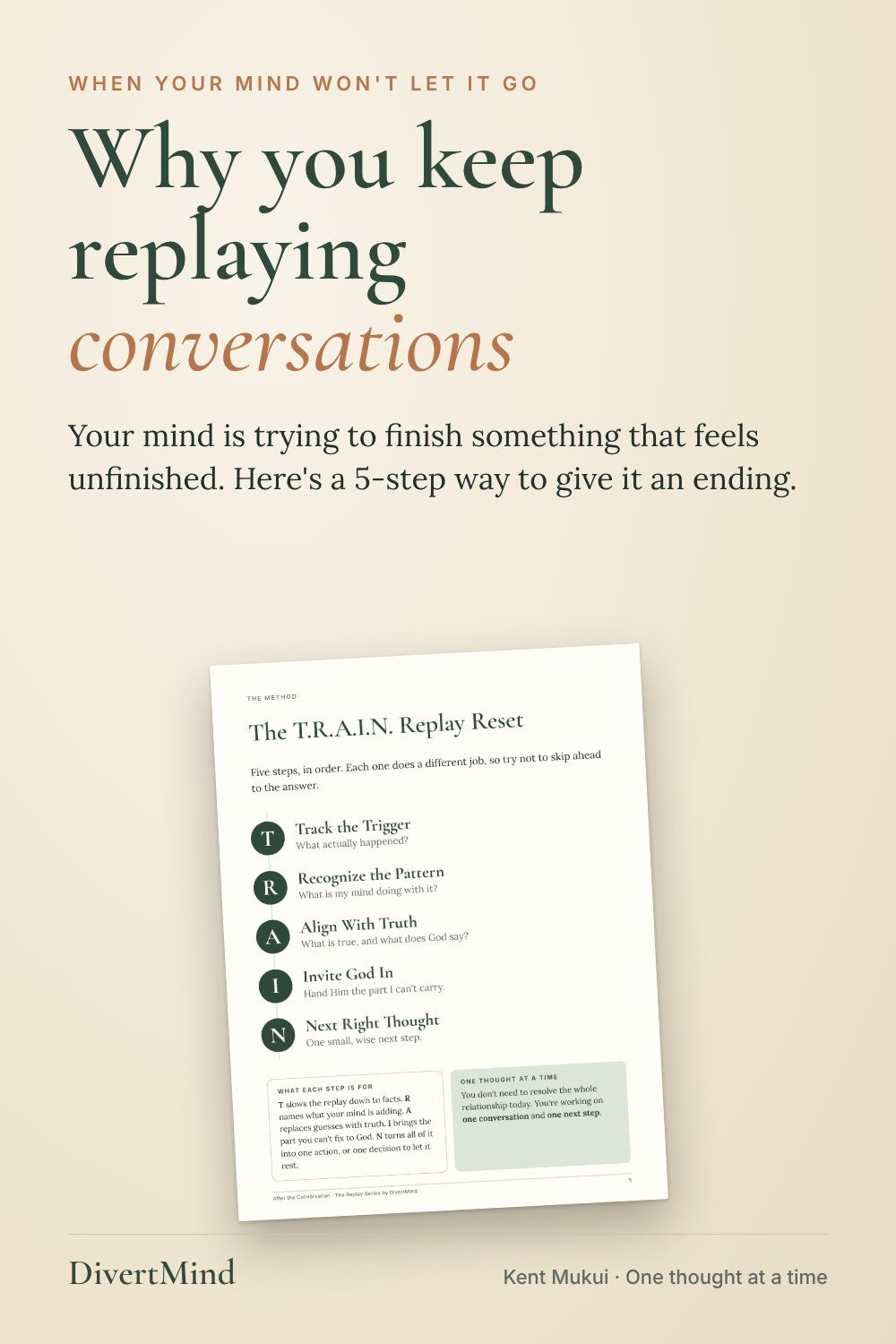
This is the T.R.A.I.N. method I use at DivertMind, applied to one conversation:
- Track the Trigger. Write down only what a camera would have recorded. The words, not the tone you sensed.
- Recognize the Pattern. Name what your mind is adding: rewinding, mind-reading, a verdict like “I always ruin things.”
- Align With Truth. Write one true sentence about the situation and one about yourself. “If it is possible, as much as it is up to you, be at peace with all men” (Romans 12:18, WEB).
- Invite God In. Tell Him plainly what you can’t control. “…casting all your worries on him, because he cares for you” (1 Peter 5:7, WEB).
- Next Right Thought. Choose one: repair, clarify, wait 24 hours, or release. Then stop.
When it’s more than replaying
If replaying regularly costs you sleep, work or relationships, or the thoughts feel intrusive or frightening, talk with a doctor, counselor or pastor. If you’re in crisis in the U.S., call or text 988.
Keep going
- Free: the T.R.A.I.N. Starter Kit, with the method on one page, a daily sheet and a Scripture card.
- For one conversation you can’t let go: After the Conversation, a 20-page workbook that walks one replayed conversation through all five steps.
- If your mind never seems to switch off: My mind is always thinking about something.
- Go deeper: Take Back Your Thoughts by Kent Mukui (writing as Eli Divert).
DivertMind shares faith-based reflection tools, not therapy or medical advice.
About the author
Kent Mukui is the founder of DivertMind and creator of the T.R.A.I.N. Method. He writes Scripture-grounded reflections and develops guided journals and educational workbooks for people navigating overthinking, ADHD mental noise and difficult seasons. He is also the author of Take Back Your Thoughts, written under the pen name Eli Divert and available on Amazon. Meet Kent Mukui.
Leave a Reply